

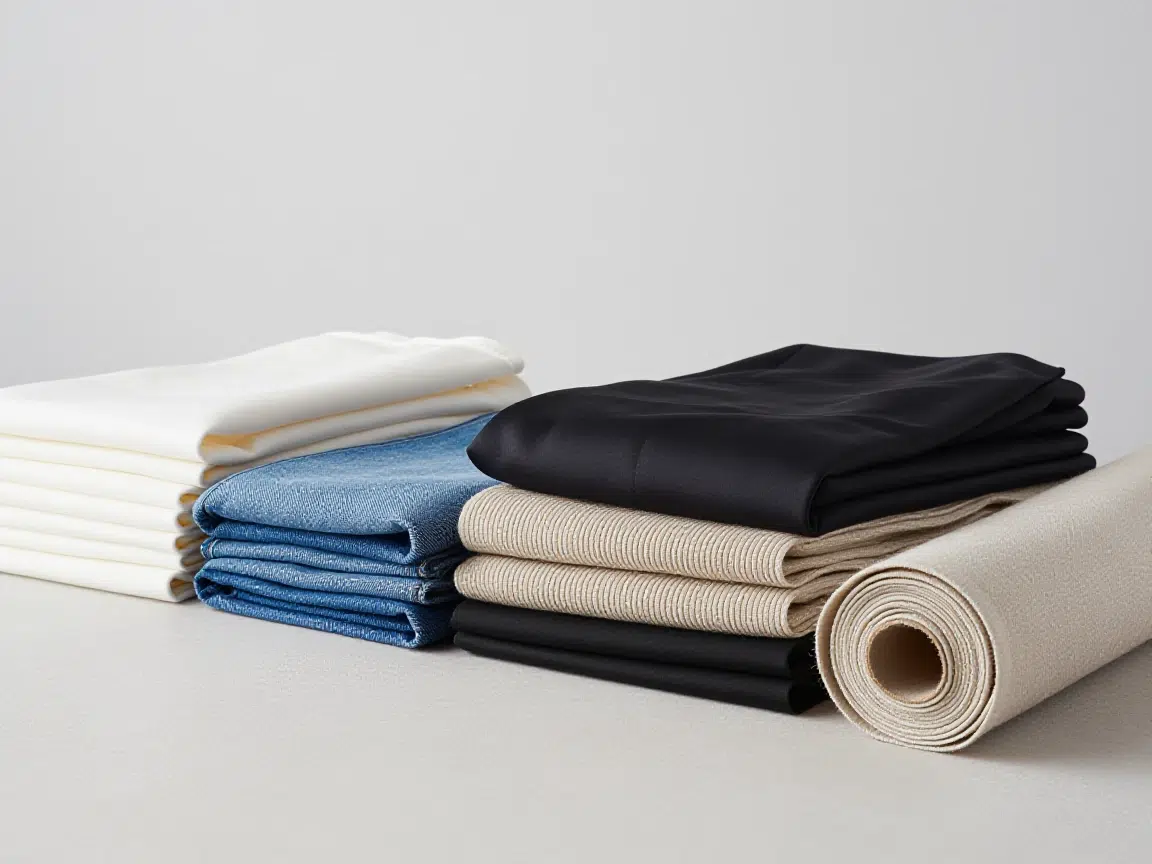
In October 2026, Fashion for Good launched its Cotton Reloop Matrix Project — a benchmarking effort built on a blunt observation: mechanically recycled cotton is technically ready to scale, but brand hesitation over quality and consistency is what keeps it out of production lines. The same month, the Textile Exchange Conference brought more than 1,300 people from brands, mills and suppliers together with one message repeated from the stage: the industry has spent years getting “ready,” and now has to act. Both stories point to the same place. Before a fabric ever reaches a cutting table, somebody has to write a fiber and a weight on a spec sheet — and that decision quietly sets your price, your shrinkage, your returns rate and your entire production calendar.
At 3Nice Clothing, we manufacture garments for independent labels and growing brands across wovens, knits and denim, and fabric selection is where most first-time collections go right or wrong. Below is the working version of the conversation we have with brand owners — the fabric families worth knowing, what each one costs you in trade-offs, the numbers to put on your spec, and the five questions to ask before anyone books yardage.
Why fabric choices are now commercial decisions, not aesthetic ones
Ten years ago, fabric was a taste call. Today it is a compliance and margin call as much as a design one. Recycled-content claims are being audited, EU traceability rules are moving toward per-product data, and buyers in the US and Europe increasingly ask for fiber composition plus test results before they place a repeat order. A fabric that photographs beautifully but shrinks 6% in the first wash will cost you more in replacements than the fabric ever cost to buy.
The practical consequence: pick fabric for how it behaves after three washes, not how it looks on a hanger. Everything below is organized around that idea.
Wovens and knits: the first distinction to get right
Almost every fabric decision starts here, and getting it wrong is expensive because woven and knit garments cannot be substituted for one another in a pattern.
- Wovens — yarns interlaced on a loom. They hold a shape, press crisply, and take structured silhouettes: shirts, tailored trousers, blazers, skirts, dresses with defined volume. They have limited stretch unless elastane is added, and they fray at the cut edge, which is why seam finishing matters more.
- Knits — loops interlocked instead of interlaced. They stretch, recover and drape, which makes them forgiving in fit and comfortable in wear: tees, dresses, hoodies, rib trims, swim. They can also grow out of shape, so recovery and pilling are the two tests that matter.
If you are building a first collection, choose one family and go deep. A brand that books four woven fabrics used across eight styles will negotiate better, sample faster and keep color continuity across the range. A brand that books twelve fabrics for twelve styles spends its entire development window chasing swatches.
The fabric families brands actually book
These are the groups that cover the overwhelming majority of real orders we run. Each line is the honest trade-off, not the marketing version.
- Cotton poplin and twill — the workhorses. Poplin is smooth, fine and slightly crisp; twill is denser with a visible diagonal and hides wrinkles better. Both take print and embroidery cleanly. Trade-off: they wrinkle, and low-grade cotton goes thin and fuzzy after a season.
- Linen and linen blends — best-in-class for summer hand-feel and the natural texture that reads as expensive in photography. Trade-off: it creases by design and shrinks more than cotton, so a linen-blend or washed finish is usually the smarter commercial call than 100% linen.
- Viscose, modal and lyocell — fluid drape with a soft, cool hand, which is why they dominate slip dresses, wide-leg trousers and resort. Trade-off: they are weaker when wet, can shrink or distort if washing is careless, and quality varies enormously between suppliers.
- Wool and wool blends — the category where blend ratio does the most work. A blend with a modest cashmere or fine-wool percentage delivers most of the perceived luxury of a pure fiber while holding shape better and tolerating a lower price point. Trade-off: pilling and shrinkage if the blend is unbalanced.
- Silk and satin-finish fabrics — for evening and occasion. Trade-off: the highest care burden in the range, and the fabric where a cheaper substitute is most visible in person even when it looks fine on screen.
- Denim — cotton twill with weight doing the design work. Rigid, comfort-stretch and high-recovery versions behave like three different fabrics. Trade-off: shade consistency between lots and shrinkage control after wash.
- Jersey, interlock, rib and fleece — the knit backbone. Jersey is light and drapey, interlock is smoother and more stable on both faces, rib gives you the stretch panels and trims, fleece gives you weight and warmth. Trade-off: recovery and pilling separate the good from the cheap.
- Performance and recycled blends — recycled polyester, recycled cotton and bio-based synthetics. Trade-off: recycled cotton loses staple length, so it is usually blended rather than used alone; the honest ceiling for a strong, clean-looking fabric sits well below 100% recycled content.
Weight is a spec, not a feeling
Most quality problems that get blamed on “cheap fabric” are actually weight problems. Put a grams-per-square-meter target on your spec sheet and hold the mill to a tolerance, typically plus or minus 5%. Rough working ranges:
- Light shirting and blouses: 80–120 gsm
- Dresses and soft trousers: 110–160 gsm
- Structured trousers, skirts, light jackets: 180–280 gsm
- Hoodies and sweatshirts: 280–380 gsm
- Denim: 10–14 oz, with 11–12 oz the safe middle for year-round wear
Ask for the tested weight in writing, not the mill’s catalogue number. A “180 gsm” that arrives at 165 gsm is a different garment.
Five things to confirm before you commit to a fabric
This is the list that separates brands who reorder smoothly from brands who spend their second season on damage control.
- Shrinkage after wash — ask for the actual tested figure for the finished garment, not the greige fabric, and confirm whether the fabric is pre-shrunk or washed. Anything above 3% on a woven needs to be built into the pattern.
- Pilling grade — a 3–4 or better on the standard scale for knits and wool blends. Below 3, expect fuzz and pills within a few wears, and expect complaints.
- Color fastness — a 4 or better to washing, rubbing and light. This is the single most common failure that turns a good style into a return.
- Skew and torque — the twist you see in cheap jersey after washing. Ask what the tested figure is on the finished garment; it is the quiet killer of knit dresses and tees.
- Hand after three washes — not the swatch hand. Ask for a wash-tested sample piece, or approve the fabric only after the mill’s own wash test. Softness that disappears after one laundry cycle is not softness.
Lower-impact fabric without wrecking the hand
The recycled conversation is worth having, but it has to be practical. Mechanically recycled cotton has shorter fibers, so it blends: a portion of recycled cotton with virgin cotton gets you a credible sustainability story while holding strength and surface cleanliness. Recycled polyester works well in fleece, linings and performance knits where a slightly drier hand is acceptable. Where it gets difficult is silk-substitute eveningwear and fine-gauge knits, where hand-feel is the entire product.
The useful rule: choose the fiber story your fabric can actually carry, and only claim what you can document. With traceability expectations tightening, a modest, fully documented recycled percentage is worth more than an ambitious number you cannot prove.
Where fabric sits in your cost structure
Fabric is almost always the largest single line in a garment’s cost, which is why a 5% fabric change moves the whole plan. A typical breakdown for a mid-market woven or knit style:
- Fabric: 45–60%
- Trims, thread, interlining, labels and packaging: 5–8%
- Cut, make and sewing labor: 20–30%
- Washing, dyeing or finishing processes: 5–10%
- Quality control, pressing and packing: the remainder
Two implications follow. First, saving money on trims is almost pointless — it is the smallest line and the most visible in wear. Second, if you need to hit a target cost, change the fabric weight or blend, not the seam allowance.
Why brands work with 3Nice on fabric
- We develop fabric with the garment in mind. The weight, the shrinkage allowance and the wash route get matched to the style, so the sample you approve is the production you receive.
- Sampling before commitment. We build the first sample in the closest available quality, so you see the real hand and drape before any bulk fabric is booked.
- Testing, not opinions. Shrinkage, pilling, color fastness and skew are confirmed with test results you can forward to your own buyers.
- One team across wovens, knits and denim. A collection that spans shirting, jersey and denim does not need three separate suppliers with three separate calendars.
- Production you can watch. Every order runs through ThreadFlow, our production tracking platform, so fabric in-house dates, cutting and finishing progress are visible instead of assumed.
If you are still mapping out the wider process, our guide to developing fabrics with a manufacturer covers how the fabric conversation fits into development, and how a tech pack becomes a sample explains what to send us first. Once fabric is set, garment construction quality is where the next set of decisions lives.
Start with the fabric, not the sketch
Most brands sketch first and pick fabric last, which is exactly backwards: fabric dictates the silhouette, the seam, the wash route and the price. Bring us a reference garment, a fiber direction, or even a photo of a texture you like, and we will tell you what it takes to build it properly.
If you want the short version first, start at the 3Nice Clothing overview — it lists the categories we manufacture and how we work with brands. Then browse our manufacturing range to see the categories we run, look at the factory where sampling and production happen, or contact us with your fabric question. For a broader view of the category, our women’s collections page shows the fabrics in context, and sourcing knitwear without getting burned goes deeper on the knit side.
Related reading: quality control for small brands · how long production really takes · ThreadFlow production tracking
Related Reading: Sustainable Fashion Manufacturing