

Vietnam closed 2025 as one of the world’s three largest textile and garment exporters, shipping to 138 markets with export turnover up 6 percent year on year, and exports in the first nine months of 2026 rose another 3.3 percent, according to a November 2026 Vietnam News report. Behind those numbers, though, the country’s own industry agency is saying something brands should pay attention to: the model that produced them is running out of road. Đỗ Nam Bình, deputy director of the Industry Agency under the Ministry of Industry and Trade, told the outlet that growth built on abundant labor and low production cost is “gradually reaching its limits,” and that buyers now weigh traceability, green production, emissions reduction and social responsibility alongside price and delivery.
His follow-up line is the one worth taping to a wall. Technology spending, he argued, should be judged by real movement in labor productivity, defect rates, material consumption, delivery times and production management, “rather than simply the number of robots or AI systems installed in factories.” That is a polite way of saying most factory technology pitches are theater.
The money is moving the same direction. A late-October 2026 Sourcing Journal report found apparel supply chain capital shifting away from building more physical footprint and toward what it calls “technological density” — computer-vision systems doing zero-touch quality checks and barcode verification, RFID replacing manual scanning, robotics handling what people used to pick by hand. UPS has automated 63 percent of its hub volume and now describes its own evolution as moving “from scanning to sensing.” Amazon runs more than 600,000 logistics robots.
Which sets up the honest question for anyone sourcing clothing: if your parcel carrier can tell you where a box is at 3 a.m., why can your factory still not tell you which stage your order is at? At 3Nice Clothing, that gap is what the technology conversation is actually about — not robots on a sewing floor.
What garment manufacturing technology actually changes for a brand
Almost none of it looks like automation in a car plant. Sewing a garment is still a sequence of flexible-material operations that resist machines, which is exactly why the industry has automated cutting, inspection and tracking far faster than it has automated stitching. The useful question is not “how automated is the factory” but “which of my problems does the technology remove.”
In practice, four things change, and all four are things a brand owner feels within one season:
- Defects get caught before the garment exists. The cheapest defect is the one found in fabric, not in a finished piece.
- Re-orders match the first order. Color and fit drift between runs is the most common complaint from emerging labels.
- The cut is accurate across the whole lay. Size and shade errors are born in the cutting room, not at the machine.
- You can see the order without emailing anyone. Status data, not status promises.
The systems that matter — and what each one buys you
Digital patterns and 3D sampling. A pattern that exists as a digital file can be graded, adjusted and rendered before any fabric is cut. For a brand, the measurable result is fewer physical sample rounds and less calendar time burned waiting for a courier. We use this to lock fit and proportions earlier, which matters most on structured pieces — jackets and coats where a two-centimeter shoulder change alters the whole silhouette.
Automated spreading and cutting. Hand cutting varies with the operator’s eighth hour of a shift; a machine does not. On a lay of forty plies, the difference shows up as consistent grain line and clean edges on every piece, and as a lower re-cut rate when a panel is damaged. Ask any factory what percentage of cut panels get re-cut in a season. It is a technology question disguised as a housekeeping question.
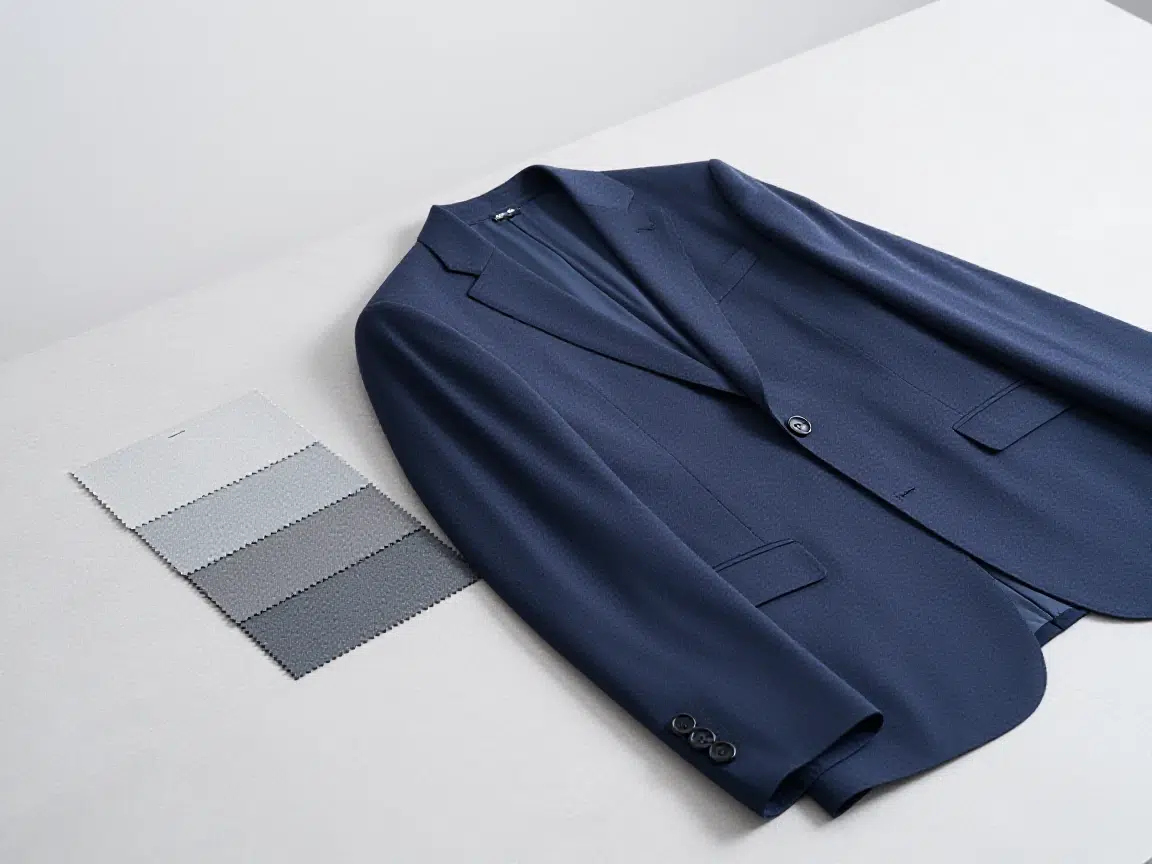
Fabric inspection before cutting. This is the highest-leverage technology in the building and the least glamorous. Rolls are run over a lit inspection frame and graded on the four-point system, producing a defect map: this roll has a slub at 12 meters, a shade bar at 30. The cutter then places the defect in a seam allowance or in a part of the marker that becomes waste. Done properly, it converts a customer complaint into a cutting instruction. Our own production floor runs inspection before the marker is laid, which is why we can talk about fabric behavior before it becomes a garment problem.
Digital color management. “It looked closer on the lab dip” is a sentence that should not exist in a supply relationship. Reading bulk fabric on a spectrophotometer and holding it to a written tolerance against the approved standard turns color from an opinion into a number. For reorders on knitwear and denim — two categories where dye lots and wash lots drift — this is the difference between a replenishment and a redevelopment.
Work-in-progress tracking. Barcode or RFID reads at cutting, sewing lines, finishing and packing produce a status feed rather than a weekly summary. This is the piece brands underestimate, because it is the only technology on the list that changes your day rather than the factory’s. It is also the reason we built ThreadFlow — order status lives in a system both sides read, instead of in a chain of forwarded emails.
The six numbers to ask a factory for before you sign
You do not need to audit a factory’s equipment list. You need six numbers, and any factory genuinely running this technology will have them at hand. If the answers are vague, the technology is decoration.
- First-pass yield — the share of pieces that pass first inspection without rework. A factory that cannot quote this is not measuring quality, only reacting to it.
- Defect rate by category — overall figures hide everything. What matters is the rate on your construction type.
- Re-cut rate — panels cut a second time as a share of panels cut. High numbers mean either poor fabric or poor cutting control.
- Inspection points per 100 meters — and who inspects: in-house team, or a third party on request.
- Color tolerance in writing — the numeric tolerance against the approved standard, plus how bulk is measured and by whom.
- On-time delivery for the last twelve months — and the definition used. Ex-factory date and ship date are not the same number, and the gap between them is where most “our factory is late” stories actually live.
Add one more, less technical: can you see the production status yourself, without asking? If the answer involves a screenshot, the answer is no. Our guide to quality control for small brands goes deeper on what to check when you do get access to the floor.
Why brands choose 3Nice for production
We are a manufacturer, not a trading desk, which means the technology sits on the same floor as the garments and the person answering your question can walk to it.
- Digital-first development — tech packs translated into pattern files and 3D review, so fit questions get resolved before fabric is committed.
- Fabric inspection before cutting — graded rolls, defect maps, and a cutter who knows where the flaws are.
- Color control by measurement — bulk read against the approved standard, with the tolerance written down.
- Construction standards that do not move — the details that make a piece hold up are documented, not left to whoever is on the machine. Our garment construction guide shows what we hold to.
- Visible status through ThreadFlow — stage-level tracking both sides can read, replacing the “any update?” email.
- Fabric and trim sourcing in the same conversation — material decisions and production decisions are made by the same team, which is where most cost surprises get prevented. See what designers need to know about fabric sourcing.
Where technology shows up in your cost structure
Technology does not appear as a separate line on a quote, which is why buyers miss it. It is redistributed across the cost of a garment, roughly like this for a typical cut-and-sew piece:
- Materials — 50 to 60 percent. The single biggest beneficiary of inspection and marker efficiency. Better utilization and fewer wasted panels move this number in your favor.
- Labor — 20 to 25 percent. Reduced mostly by catching defects early, since rework is labor you pay for twice.
- Overhead, equipment and technology — 8 to 12 percent. Inspection frames, cutting systems, color measurement, tracking software. This is the line that looks like cost and behaves like insurance.
- Trims, finishing and packing — 5 to 10 percent. Where automation is least relevant and craft matters most.
The practical takeaway: you are not paying for machines. You are paying for first-pass yield, and the factories that run these systems properly are usually the ones whose quotes survive contact with a real production run. A slightly higher unit cost with a 95 percent first-pass yield beats a lower one with a rework cycle, every season.
If you want to see how this maps onto a live program, our sustainable manufacturing guide covers the compliance side of the same data, and our fabric types guide explains which materials reward this level of control.
Next step
Browse the 3Nice product range to see the categories we build, or contact us with a tech pack and we will tell you what the first-pass yield on your construction is likely to be — and what we would change to raise it.
Related reading: Garment Quality Control for Small Fashion Brands · Garment Construction Guide · How Long Custom Manufacturing Really Takes · Resources for Emerging Brands